This Is MS Multiple Sclerosis Community: Knowledge & Support

Welcome to the world's leading forum on Multiple Sclerosis research, support, and knowledge. For over 10 years, This is MS has provided an unbiased community dedicated to Multiple Sclerosis patients, caregivers, and affected loved ones.
It is currently Mon May 20, 2013 3:23 pm


All times are UTC - 8 hours [ DST ]


Post new topic Reply to topic  [ 31 posts ]  Go to page 1, 2, 3  Next
Author Message
PostPosted: Fri Aug 12, 2011 11:01 am 
Offline
Family Elder
User avatar

Joined: Mon Sep 10, 2007 3:00 pm
Posts: 4676
Location: southern California
The recent release of information on new genes identified in MS from Dr. Compston et al in no way refutes the connection of CCSVI.

Genes are interrelated, and there are complex connections between immune system genes and vascular genes. The endothelium is responsible for both the immune system reactions and vascular formation via interactions.

Here is Dr. Ferlini's study which found shared copy number variations in pwMS and in those with venous malformations, in toto:

Quote:
The region we analysed contains 211 known genes. By using pathway analysis focused on angiogenesis and venous development, MS, and immunity, we tentatively highlight several genes as possible susceptibility factor candidates involved in this peculiar phenotype.
Conclusions: The CNVs contained in the HLA locus region in patients with the novel phenotype of CCSVI/VM and MS were mapped in detail, demonstrating a significant correlation between the number of known CNVs found in the HLA region and the number of CCSVI-VMs identified in patients. Pathway analysis revealed common routes of interaction of several of the genes involved in angiogenesis and immunity contained within this region.


http://www.fondazionehilarescere.org/pd ... -final.pdf

Here is research I compiled on one gene found in those with venous malformations. This gene is also found in t-cell modulation:
link to note

Quote:
This gene, FAP48, is also noted as an immune modulating gene. FAP48 is found to contribute to venous malformations, and it is also found to modify t-cell immune response. Many genes, as Dr. Ferlini's study shows, have this kind of interaction.


It is far too simplistic to claim that finding new immune system genes in MS refutes the vascular connection. Any geneticist will tell you, this is far more complex than that. Just look at the genetic study of scleraderma as a start....most of the vascular and immune genes in that disease are interrelated. It is hubris for Dr. Compston to claim, at this early point in the discovery process, that these new genes prove MS is immune.
cheer

_________________
Husband dx RRMS 3/07
dx dual jugular vein stenosis (CCSVI) 4/09
dual stents placed 5/09
CCSVI in MS


Top
 Profile  
 
 Post subject:
PostPosted: Fri Aug 12, 2011 11:08 am 
Offline
Family Elder
User avatar

Joined: Mon Sep 10, 2007 3:00 pm
Posts: 4676
Location: southern California
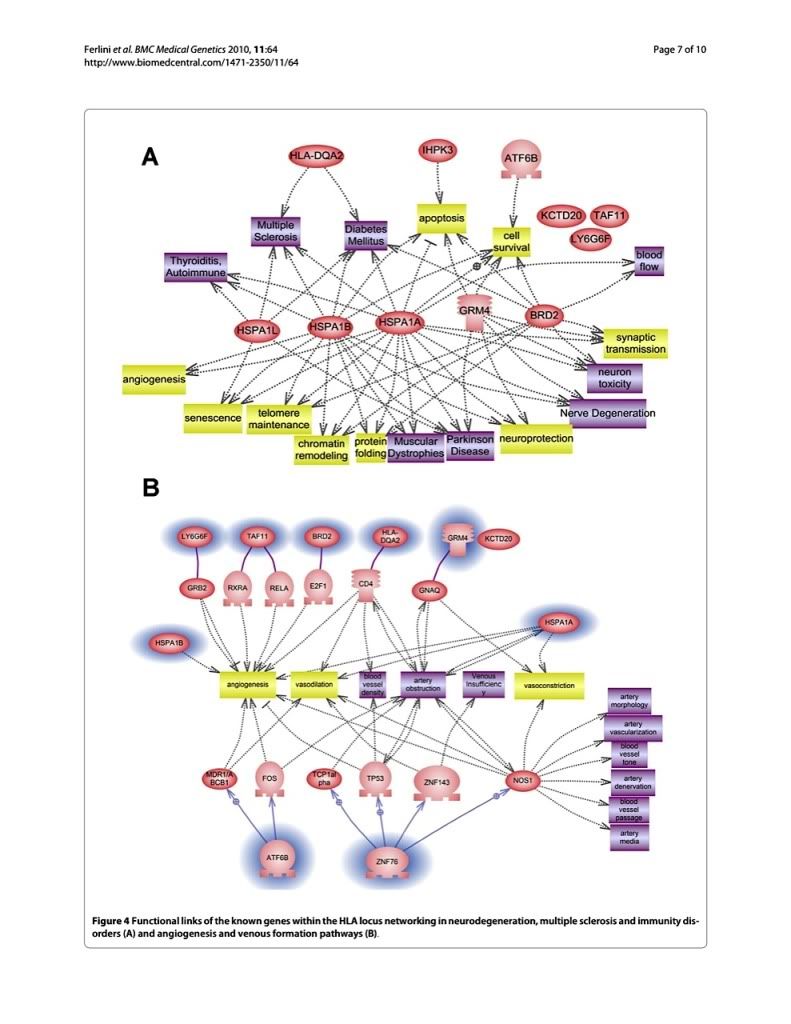
Here is a diagram illucidating the functional interactions in the HLA locus found in MS, neurodegeneration and immune system disorders. As you will note, there is much crossover.

http://www.flickr.com/photos/ccsvitoronto/6035560439/

cheer

_________________
Husband dx RRMS 3/07
dx dual jugular vein stenosis (CCSVI) 4/09
dual stents placed 5/09
CCSVI in MS


Top
 Profile  
 
 Post subject:
PostPosted: Sat Aug 13, 2011 3:40 pm 
Offline
Family Elder
User avatar

Joined: Mon Sep 10, 2007 3:00 pm
Posts: 4676
Location: southern California
Here is Dr. Ferlini's chart showing the connection between immune system genes and vascular genes within the HLA locus associated with MS. There is a robust correlation between these genes. The immune and vascular systems communicate via the endothelium...they are interconnected.

Image

_________________
Husband dx RRMS 3/07
dx dual jugular vein stenosis (CCSVI) 4/09
dual stents placed 5/09
CCSVI in MS


Top
 Profile  
 
 Post subject:
PostPosted: Sat Aug 13, 2011 3:59 pm 
Offline
Family Elder

Joined: Mon Jan 04, 2010 4:00 pm
Posts: 8506
These are genes that are identified as playing a role in the immune system but they are also identified as playing a role in the vascular system? They overlap, in other words.


Top
 Profile  
 
 Post subject:
PostPosted: Sat Aug 13, 2011 4:13 pm 
Offline
Family Elder
User avatar

Joined: Mon Sep 10, 2007 3:00 pm
Posts: 4676
Location: southern California
Cece wrote:
These are genes that are identified as playing a role in the immune system but they are also identified as playing a role in the vascular system? They overlap, in other words.


exactly Cece. They overlap. Follow the links to see the interactions--
In the top chart, the genes known to be related to MS (all in the HLA locus) are in the center, and their connections radiate outward. As an example, HSPA1A is related to MS and other immune disorders.

In the bottom chart, you can see how involved HSPA1A is involved in vasoconstriction, vasodilation, and venous insufficiency. HSPA1A is just one example of a gene that functions in autoimmune diseases and vascular diseases. These genes are not just functioning in one area....the vascular and immune systems are related.
cheer

_________________
Husband dx RRMS 3/07
dx dual jugular vein stenosis (CCSVI) 4/09
dual stents placed 5/09
CCSVI in MS


Top
 Profile  
 
 Post subject:
PostPosted: Sun Aug 14, 2011 6:49 am 
Offline
Family Elder
User avatar

Joined: Fri Nov 27, 2009 4:00 pm
Posts: 690
Quote:
angiosenesis:Angiogenesis is the physiological process involving the growth of new blood vessels from pre-existing vessels.[1] Though there has been some debate over terminology, vasculogenesis is the term used for spontaneous blood-vessel formation, and intussusception is the term for new blood vessel formation by splitting off existing ones.[2]
Angiogenesis is a normal and vital process in growth and development, as well as in wound healing and in granulation tissue. However, it is also a fundamental step in the transition of tumors from a dormant state to a malignant one, leading to the use of angiogenesis inhibitors. The identification of an angiogenic diffusible factor derived from tumors was made initially by Greenblatt and Shubik in 1968.[3
[/quote]


Top
 Profile  
 
 Post subject:
PostPosted: Sun Aug 14, 2011 6:56 am 
Offline
Family Elder
User avatar

Joined: Fri Nov 27, 2009 4:00 pm
Posts: 690
so the genes for angiogenesis and ms are similar. The group of genes the big study is about have a different name. (don't they? HTLA or something?)
The trick would be to find out if those ones apply to angiogenesis too.


Top
 Profile  
 
 Post subject:
PostPosted: Sun Aug 14, 2011 9:40 am 
Offline
Family Elder
User avatar

Joined: Mon Sep 10, 2007 3:00 pm
Posts: 4676
Location: southern California
Billmeik wrote:
so the genes for angiogenesis and ms are similar. The group of genes the big study is about have a different name. (don't they? HTLA or something?)
The trick would be to find out if those ones apply to angiogenesis too.


Angiogenesis is only one aspect, bill. Note that vasodilation and constriction are there, too. What is most important to understand is that these functions all occur at the cellular level of the endothelium (the lining of our blood vessels and lymphatic vessels) where the immune system and vascular system are inextricably intertwined.

As soon as I can get the full Compston paper, I'll see if I can find any crossover betwen the newly illucidated MS genes, which may or may not be outside the HLA locus. But I will be you they will have vascular connections, because that's how the endothelium works. The body is one.
cheer

_________________
Husband dx RRMS 3/07
dx dual jugular vein stenosis (CCSVI) 4/09
dual stents placed 5/09
CCSVI in MS


Top
 Profile  
 
 Post subject:
PostPosted: Sun Aug 14, 2011 11:31 am 
Offline
Family Elder
User avatar

Joined: Wed Mar 17, 2010 4:00 pm
Posts: 2562
Location: Kanata, Ontario, Canada
Sorry if this slows the discussion down, but the colour scheme is a bit puzzling. It seems the yellow stuff is all normal functionality even if it might sound bad, but is really on purpose, like apoptosis, and the purple stuff is all diseases or pathologies, or stuff going wrong, but how does that include "Blood flow"? And this NOS1 gene seems to have a lot of purple boxes coming from it that all are "normal" blood vessel stuff. So how does this diagram work exactly?

_________________
"Try - Just A Little Bit Harder" - Janis Joplin
CCSVI procedure Albany Aug 2010
'MS' is over - if you want it
Patients sans/without patience


Top
 Profile  
 
 Post subject:
PostPosted: Sun Aug 14, 2011 11:34 am 
Offline
Family Elder

Joined: Mon Jan 04, 2010 4:00 pm
Posts: 8506
cheerleader wrote:
As soon as I can get the full Compston paper, I'll see if I can find any crossover betwen the newly illucidated MS genes, which may or may not be outside the HLA locus.

I'll be looking forward to your analysis.


Top
 Profile  
 
 Post subject:
PostPosted: Sun Aug 14, 2011 12:56 pm 
Offline
Family Elder
User avatar

Joined: Mon Dec 21, 2009 4:00 pm
Posts: 375
You mean Cheer that these genetic researchers may have stumbled upon the genes responsible for vascular malformations and CCSVI known to be associated with MS. I hope they are given honorable mention when Zamboni collects his Nobel prize.


Top
 Profile  
 
 Post subject:
PostPosted: Sun Aug 14, 2011 2:53 pm 
Offline
Family Elder
User avatar

Joined: Mon Sep 10, 2007 3:00 pm
Posts: 4676
Location: southern California
Caveat time. I heard Dr. Ferlini speak about this study in Bologna in '09, and it was the most confused I have ever been in my life. More confused than calculus class....here are my notes from her presentation. I just wrote what she said, and tried to decifer it at the hotel later. Dr. Ferlini was looking at the loci already associated with MS. She found much crossover into venous malformation and CCSVI. I agree, she deserves a Nobel...she's still studying CCSVI genetics and families, and has more publications to come.

Quote:
Dr. Alessandra Ferlini- geneticist at Universite deglie Studi di Ferrara
SNPs are single nucleotide polymorphisms- and they reveal a multi-loci susceptibility to MS. The 4 specific loci are MS1, MS3, MS4, MS2. These are the chromosomes most linked to MS

Genetics is still questioned in this research, since there are undefined environmental factors.

Genome inflation- a characteristic of SNPs may hamper the true definition of identified genetic loci by SNP association. More studies are needed.

Interactome- the interaction of phonemics, genomics, preteomic, metabolic studies- all together-
This is done in genomic studies using CGH array rather than SNPs

The Ferrara study looked at CNVs (copy number variations) of chromosome 6p21.32 (HLA locus) in CCSVI patients.
CGH verified the occurrence of CNVs in the major locus of MS patients.
15 unrelated CCSVI patients were tested. No relation between the topography of CNVs and phenotype were shown....
but there was a significant relation between the number of extragenic CNVs and the phenotype correlated with venous malformations.

HSPAIL, HSPIA, HSPIB (heat shock proteins) were related to angiogenesis and immunity. HLADLAZ and CD4 are involved in proinflammatory disease and tumor angiogensis. There are multiple gene disorders, and environment has a large influence.

The genome imbalance may be sensitive to environmental factors.

There was a significant correlation between the number of CNVs and the number of venous malformations. The number of polymorphic CNVs in the HLA region linked to MS does correlate with the number of venous malformations in MS patients.

This is a new way to study genetic disorders- to look for mutations on more than one genome. It is a very complex system, and cannot be narrowed to one genome.

Dr. Frohman asks if this has been tested in families? Are there genes affected in relatives with other autoimmune diseases?

Dr. Ferlini answers that this is a pilot study, and it is the first time looking at this paradigm. Future testing will look at families.

Dr. Lee comments that we have much genetic data on lymphatic malformation, yet no studies on the genetics of venous malformation. The veno-lymphatic systems need to be brought together. They have been separated and we need more venous information.

Dr. Ferlini comments that a similar phenotype can involve many genes, it depends on how they interact in the pathway. We need to locate many genes and understand how they interrelate, when they switch on and off, and how they interact in polygenetic disorders.


The basic takeaway I got from this lecture, and Dr. Ferlini's published paper, was that these genes known to be related to MS, affect the immune system and venous malformations. They are not just involved in one system.

As far as the colors on the diagram, I think it's about location of the boxes, not just color. Yellow is normal function, purple center is immune/neurodegenerative/vascular disease, red are the genes.
Those purple boxes on the right hand side are normal vascular function. Different than the purple center boxes, which are disease related. I think....

I got the full Compston paper...and honestly, I can't find any new stuff. It looks like the same old MS HLA loci, but I'll dig in later and see what's in there. I really wish SOMEONE in the press had picked up on Ferlini's research before using Compston's quote that his genetic research proves CCSVI is bunk. I can't believe the press people don't do any further research, and just take his pronouncement as fact. ugh.
cheer

_________________
Husband dx RRMS 3/07
dx dual jugular vein stenosis (CCSVI) 4/09
dual stents placed 5/09
CCSVI in MS


Top
 Profile  
 
 Post subject:
PostPosted: Mon Aug 15, 2011 6:32 pm 
Offline
Family Elder
User avatar

Joined: Mon Sep 10, 2007 3:00 pm
Posts: 4676
Location: southern California
This thread is suggested reading for those who are referencing Compston's study. Many of the "immunologic" genes associated with MS from the HLA locus have crossover into the vascular realm.

_________________
Husband dx RRMS 3/07
dx dual jugular vein stenosis (CCSVI) 4/09
dual stents placed 5/09
CCSVI in MS


Top
 Profile  
 
 Post subject:
PostPosted: Mon Aug 15, 2011 6:38 pm 
Offline
Family Elder
User avatar

Joined: Wed Nov 05, 2008 4:00 pm
Posts: 1323
cheerleader wrote:
This thread is suggested reading for those who are referencing Compston's study. Many of the "immunologic" genes associated with MS from the HLA locus have crossover into the vascular realm.


I would suggest asking a genetic specialist about these so called connections instead of relying on anyone on a support forum, including me, to make any kind of scientific connections.


Top
 Profile  
 
 Post subject:
PostPosted: Mon Aug 15, 2011 6:40 pm 
Offline
Family Elder
User avatar

Joined: Mon Sep 10, 2007 3:00 pm
Posts: 4676
Location: southern California
scorpion wrote:
cheerleader wrote:
This thread is suggested reading for those who are referencing Compston's study. Many of the "immunologic" genes associated with MS from the HLA locus have crossover into the vascular realm.


I would suggest asking a genetic specialist about these so called connections instead of relying on anyone on a support forum, including me, to make any kind of scientific connections.


Dr. Ferlini is a genetic specialist, and I have linked her paper, in toto, and her charts above. She spoke about the high level of cross over and "robust correlation" of vascular and immunological genes in CCSVI/MS. I merely transcribe and post.

Here is her paper, once again-
http://www.fondazionehilarescere.org/pd ... -final.pdf
thank you,
cheer

_________________
Husband dx RRMS 3/07
dx dual jugular vein stenosis (CCSVI) 4/09
dual stents placed 5/09
CCSVI in MS


Last edited by cheerleader on Mon Aug 15, 2011 6:47 pm, edited 1 time in total.

Top
 Profile  
 
Display posts from previous:  Sort by  
Post new topic Reply to topic  [ 31 posts ]  Go to page 1, 2, 3  Next

All times are UTC - 8 hours [ DST ]


Related topics
 Topics   Author   Replies   Views   Last post 
There are no new unread posts for this topic. Genetics/Azygous

Rokkit

8

1260

Wed Sep 16, 2009 10:43 am

mormiles View the latest post

There are no new unread posts for this topic. BMC Medical Genetics

PanosB

2

1088

Wed Apr 28, 2010 3:13 pm

thisisalex View the latest post


Who is online

Users browsing this forum: No registered users


You cannot post new topics in this forum
You cannot reply to topics in this forum
You cannot edit your posts in this forum
You cannot delete your posts in this forum

Search for:
Jump to: